Why did the confirmation bias folks get things so wrong? The answer — which is a bit of an open secret — is that the entire field of cognitive biases and heuristics is built around a flawed methodology. The field conducts experiments by administering toy problems to unskilled test subjects (undergrads, mostly) in artificial lab environments. All the cognitive processes demonstrated by the participants in these studies are then labelled as ‘reasoning errors’ or ‘biases’ whenever they result in the wrong answers. And make no mistake: these cognitive processes are real; the vast majority of them are reliably replicated in lab study after lab study, over the course of decades. But if you study practitioners solving real problems in naturalistic environments — problems that they have actual expertise in — you will find that all the same cognitive processes that result in ‘reasoning errors’ on lab tests are suddenly deployed in ways that produce excellent performance. This has been the finding of the Naturalistic Decision Making (NDM) branch of applied psychology — which Klein helped start — in study after study, ‘bias’ after ‘bias’, for the past 30 years.
I can write a longer essay about this ‘open secret’. Perhaps I will. But I want to leave you with the following observation: whenever you see a cognitive bias, you should understand that there are two ways to get better performance. You may do error reduction, or you may fix it by gaining expertise.
This part (all bold emphasis mine) echoes a practical takeaway suggested by @Jared_Peterson in a piece on the related schools of thought (again, bold emphasis mine) —
Conclusion
Should these schools of thought reconcile into one unified discipline? I’m not sure. Each has its strengths, and I worry about what might be lost in the process.
Maybe instead of seeing them as competing theories striving for comprehensiveness, we should think of them as tools, each illuminating different aspects of decision-making. HB and FF uncover heuristics; HB explains when they go wrong, and FF explains when they go right, while NDM shows what happens when heuristics are chained together by experts into larger macrocognitive processes like Recognition-Primed Decision Making (RPD) in the real world. Meanwhile, CDM explains what to do in certain types of well-defined problems.
[…]
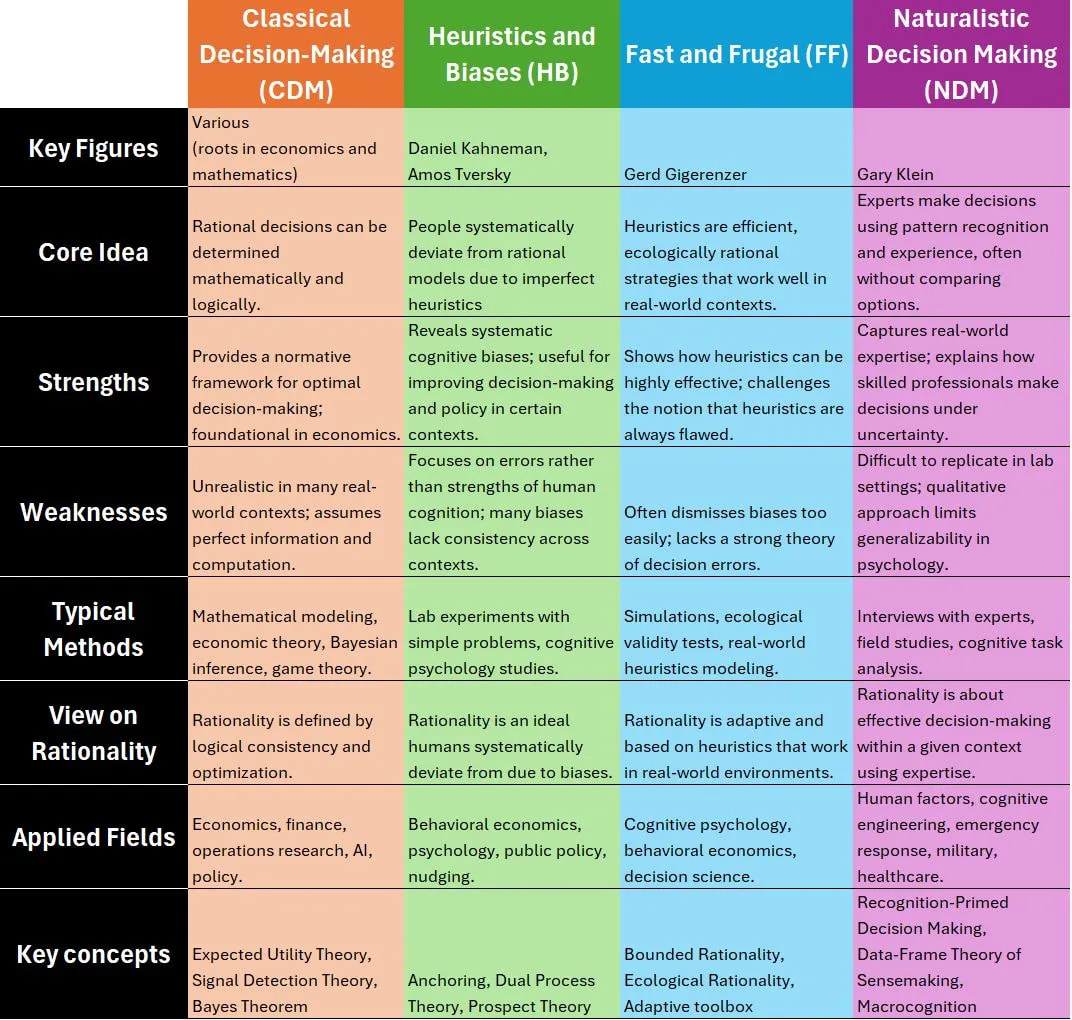
—which has been an excellent primer for me to think about what I can learn and use from these four schools of thought. One reason is that the temporal accounts in that piece are well organized and can serve as a mnemonically sticky resource for the landing phase when reading related topics (or, after you have landed as a non-researcher, for strengthening your foothold without expanding much, for that matter).