All the ideas of the Heart of Innovation, compressed into one piece.
In the months since I published my summary of The Heart of Innovation, I’ve talked to author Merrick Furst a few more times, debated the ideas in Commoncog’s members forum, and attempted to apply the ideas in a couple of businesses. To be absolutely honest I wasn’t 100% satisfied with my summary — the ideas still felt remarkably slippery despite the months of work. But I persisted; I continue to believe that HOI’s ideas are the best thing we have for ex-ante demand. (I’ll explain what this means in a bit).
Great timing for me, as I was just re-reading the JTBD articles to compare and contrast with HOI. I was quite surprised at the Bob Moesta case: it could have been a case in HOI about finding authentic demand via hunting for not-nots in a DPI (“eldery homeowners can not-not throw out their dining room tables and they cannot-not leave their spouse to clean up the mess of their house if they pass away”). In fact, I think you could argue that Moesta found demand ex-ante… sure, he had customers to interview, but none of them were purchasing storage facility space from him. One could imagine a prospective homebuilding entrepreneur running DPIs on their neighbors and getting to the same insight.
Then there’s the conundrum that, while HOI wants you to find demand before committing to a product, every single case in the book (with the possible exception of Websphere) starts with a product (or at least the idea for a product). I’d be a lot more convinced of the ex-ante effectiveness of HOI if there was a case where someone actually started with open ended DPIs and got to a brand new idea they hadn’t thought of before.
So this is curious to me… a killer HOI case about finding surprising demand is… the JTBD origin story? HOI is about finding demand independent of a product (except every story about it starts with a product)? “Gaps” and “struggling moments” really look alike? Are these just the same theory? After a lot of back and forth (with myself), here are real differences I see between the frameworks:
JTBD has a lot more constraints. It claims all purchases follow the same pattern. And in HOI terms, it only investigates certain situations: ones where a customer makes a purchase (whether that’s your product or someone else’s). It has a taxonomy of progress and sources of energy. I’ve listened to Furst on a bunch of podcasts and I can imagine him saying “demand is weirder than that” as a rebuttal to someone running through the ideas in JTBD. I think the lack of structure of HOI is intentional in this way: they’d rather have no taxonomy than an inaccurate one, and they don’t believe an accurate one is possible for demand.
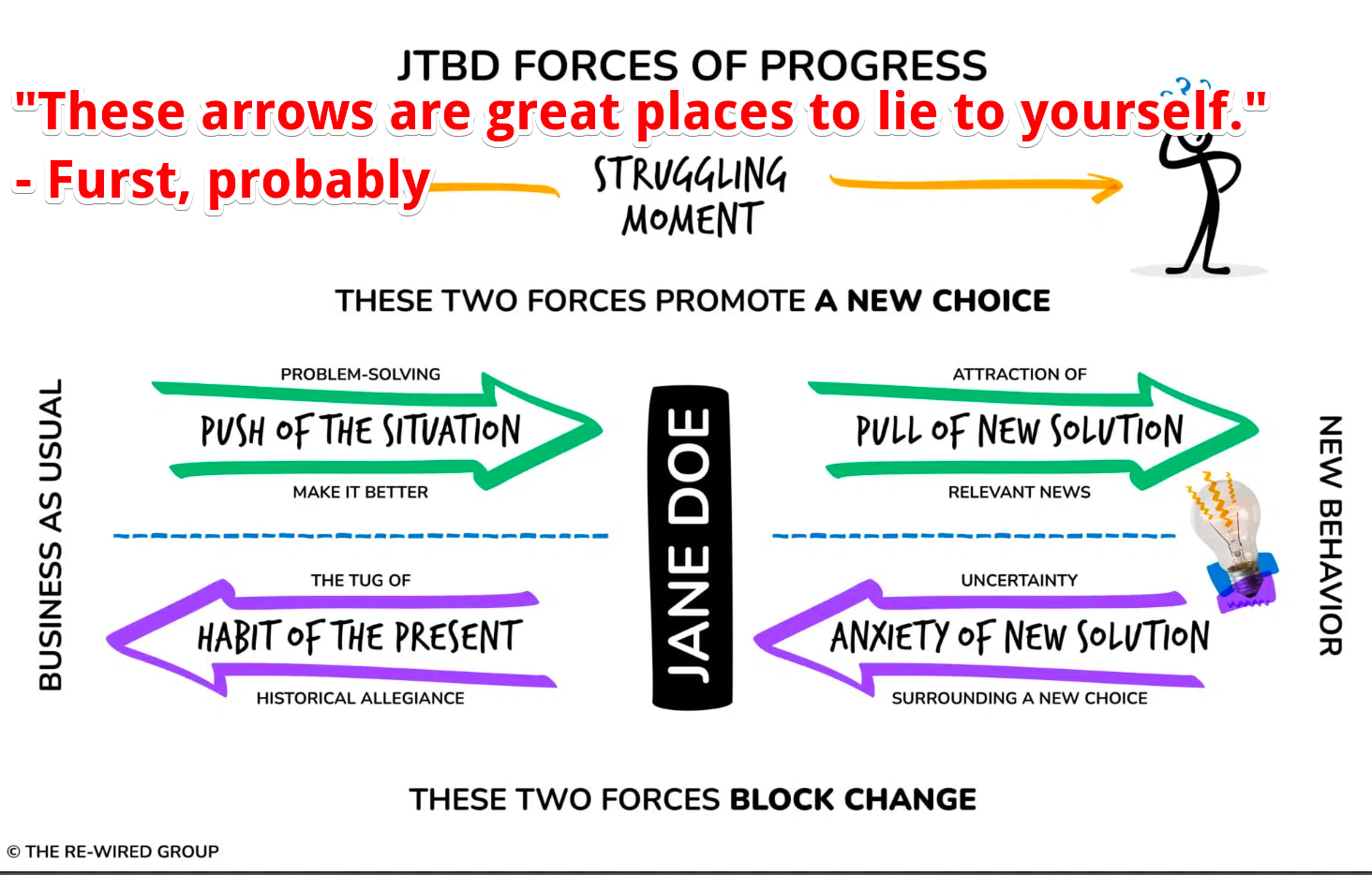
HOI focuses, in JTBD terms, on testing the “forces of progress”. I can imagine Furst looking at the JTBD diagram and saying “the theory hinges on those 4 arrows summing positive??? all i see is horribly imprecise mental math split into 4 landmines that your cognitive biases are going to walk you right into. Good luck spending 12 months realizing that the ‘pull of anxiety’ was actually a brick wall instead of the light breeze that you convinced yourself it was”. JTBD has hiring/firing criteria, but they appear to be squishier than “nonindifference”.
JTBD is positively valenced: you can construct accurate purchase stories, you just need to keep digging. HOI is negative: assume everyone is indifferent to purchasing something and that you cannot construct accurate purchase stories.
Those make HOI meaningfully different to me. It loosens most of the constraints of JTBD except the most critical one: nonindifference as a very tight constraint on believing people will purchase/use solutions. I buy that this makes it more useful for finding ex-ante demand than other theories. But it’s really interesting how neatly HOI fits the Moesta case! I’m now curious whether merging the other direction, i.e. pulling in JTBD concepts into DPIs, might be effective at times. For example, off the top of my head, aligning the focus of a situation to match the JTBD purchase timeline and re-testing for indifference, or something like that.
Also, as an aside, there’s this thing that Furst mentions a bunch in podcasts that he calls “grip to grip”. This concept isn’t in the book and he doesn’t thoroughly describe it in the podcast [The book references a “grip” when it talks about triggering “immunities” to potential solutions. I think this is where “help them do more of what they already do” stems from]. The Moesta case has a fantastic example of “grip to grip”, however:
There’s a gap for homeowners who want to downsize, and they are nonindifferent to closing it. But they can’t allow themselves to do it because their messy basement is helping them keep a grip on the emotional attachment to the decades worth of stuff that they’ve accumulated over the years. The solution is to give them a new grip that allows them to close the gap. In the case, Moesta puts a storage unit with a party room next to his housing development so that residents can store their stuff and later sort through it with their families.
I think most business books would turn that into a Proper Noun. Chapter 12: Grip to Grip Situation Modulation or something. As mentioned above, I’m curious why Furst et al, don’t do this. I suspect it’s a combination of 1) not believing you can actually categorize this stuff and 2) not wanting to distract from the one thing that actually matters: hunting for nonindifference. But I’d love to know how many “patterns” like grip to grip got left out of HOI.
Wait, but this can’t be true! RoadSync didn’t start out with an idea to target shippers, it started out as a ‘general idea to replace ComChek to save truckers pain’. But it turned out that the shape of the product had to target shippers; the truckers, who were in pain, were actually indifferent to the pain of ComChek.
Florence Healthcare (case study) was also “we wanted to build Product X, but nobody wanted it, but while doing situational diagrams we discovered a gap and then we built Product Y around it”
Oh, but I guess Florence Healthcare wasn’t in the book.
You know, I’ve mentioned in this forum how I asked Furst if he believed that HOI was a universal theory of demand, and his answer was basically “yes”. I think, being a scientist first and foremost, Furst wanted a theory that was universally true, where no counter-example could be found. A true theory doesn’t mean a useful theory though — not without work to make it more accessible, and to create more affordances for practitioners.
It’s for this reason that I didn’t add grip-to-grip mapping. I’m currently reading Immunity to Change, since Furst points at it a few times, and I think that’s where he got grip-to-grip mapping. But I’m not sure it’s important, and if it’s important, I would prefer to a) test it first to see if it’s useful, and b) come up with better, easier terminology than what they’ve come up with. (You’ll notice that not once did I say ‘DPI’ or bring up the three types of innovation in this piece).
I expect this to take me a couple more months to verify.
I labeled that as a conundrum for two reasons that are worth splitting out:
First, lemme amend part of my statement: Furst wants you to find authentic demand before you even have a product idea. Perhaps I’m overstating his perspective, but that’s what I’ve gathered from listening to him. I maintain that the case history doesn’t support that… it seems like having a solution idea is a perfectly fine way to start looking for situations as long as you don’t hold onto it tightly. Or, stated with less positive conviction, starting with a product idea doesn’t preclude you from effectively following HOI. Holding onto your product idea does, though. I have the sense that Furst’s platonic ideal for HOI is to go into it completely solution agnostic, but perhaps I’m arguing that part against a strawman I invented.
Separately, comparing HOI with JTBD for ex-ante demand, it seems like JTBD is capable of getting to ex-ante demand as long as the “purchase situation” constraint ends up being fruitful. And starting with a product idea seems like an ok way to dive into a JTBD process. For example, I can imagine both Roadsync and ETD emerging from JTBD interviews (why do shippers/truckers/lumpers “purchase” ComCheck? why do students/professors “purchase” extracurricular material?) They’re similar enough to the storage facility from Moesta’s story. So, I think JTBD can be used to find ex-ante demand. But I can’t plausibly imagine JTBD interviews recreating the Florence case, since they started pretty far outside of a “purchasing” situation and don’t use other purchasing situations to reorient themselves. So, it is compelling evidence to me that HOI is better for finding ex-ante demand.
Note that my conclusion is not “JTBD seems equivalent to HOI”. I see theoretical reasons why HOI is usefully different. And the Florence case is the best example I’ve seen to back them up. So I do agree the larger point about HOI and ex-ante demand. I just enjoy testing the edges in thought experiments and looking for evidence in the case studies.
Regarding your analogy to patients not making changes to avoid death, you might appreciate the “vitamins, painkillers, and heart surgery” metaphor that my mentor Ira Baxter used to describe mass migration projects
I wrote about it a bit in an addendum to my vitamins vs painkillers post.
“Heart surgery: Something you never want to do. But you’ll die if you don’t.
This was coined by my former employer Semantic Designs to describe their work, building bespoke tools that automatically transform large codebases. Time and time again, companies avoid solving problems that require massive change to their codebases, even when they can see disaster coming by not doing so. Consider Goldman Sachs’s Australian division, which was facing its own mini-Y2K problem by running out of daily transaction IDs. But they decided that buying a second mainframe so they could label their transactions “Mainframe A Transaction 1” and “Mainframe B Transaction 1” was easier than upgrading their codebase.
Semantic Designs’s most famous project, automatically converting the code for the B-2 stealth bomber to run on modern hardware, came after Northrup Grumman failed to upgrade it manually, and then failed again to build a tool in-house. Now the founder asks managers who come to him “Have you tried to do this kind of upgrade before?” If the answer is no, he knows that he’ll lose the sale as they try to do it in-house and fail.
Go out there and sell vitamins, sell painkillers, sell gym memberships, and sell candy. And be glad that someone else is trying to make a living providing heart surgery.”
I am a huge fan of your original painkiller and vitamin essay, and I highly recommend everybody read it (it’s linked in Parts 2 and 3 of the Demand series!)
This has been a wonderful summation of demand based selling. I have recently moved into sales role where my focus is to help grow our suite of products. This currently involves spending countless hours pitching, positioning and framing the value of the problem to prospects.
While reading the post, I was revisiting my calls with prospects. So far, I was attributing the success of few deals to the new positioning we introduced resonating with the customers. But I now see them as successes we found due to the situation we found ourselves in where “not not” buying our product.
I stopped framing that customers have problems. This ties to the Gaps topic in the post where founders find that most of the gaps are being addressed in one way or the other.
I work in a legacy space where work happens with or without us. The demand comes from prospects looking to overcome a situation they see as a challenge.
The concept of authentic demand is a layer on top of the job to be done. For example, every workflow could be done with excel but companies would like to buy software to do it in a more efficient way. The jobs to be done stay the same, we change the workflow involved in executing it.
Which brings me to the question , would there be situations where demand is generated due to technological or narrative advancement ?
Yes, but we have to find specific scenarios to figure out how situations can change from either technological or narrative advancement.
I’m just spitballing here, but two examples come to mind: the most salient one is the current AI hype cycle, which is changing what companies are buying — they’re now leaning towards AI solutions and cutting down on non-AI software.
In terms of narrative advancement, we do see changes in consumer behaviour in various markets over time! People weren’t as health conscious in the past, but now they are. And so you can see Coca-Cola and McDonald’s adapting their product offerings to take into account the higher consumer interest in health foods.
I think maybe you are referring to emergent, society level advancements, but HOI definitively answers “yes” to your question at a small scale. I’m not the first one to mention this on these forums, but Furst describes great salesmanship as an ability to craft a situation in which a potential buyer cannot not purchase. Three examples from HOI and podcasts I’ve listened to:
Magicians create a situation where people in the audience will reliably come on stage to participate in the show by first asking them to “stand up”, then asking the audience to applaud them. This makes the next request “could you please come up on stage?” a not-not for the audience member.
On James Altucher’s podcast, he tells a story (apparently real) of a real estate agent who learns his client feels like he’s good at spotting opportunities that other people miss. The agent secretly signals something over the radio to his administrative staff and tells the client “let’s go see this swampy property… most people overlook it but I think you might be able to see its potential”. The secret signal tells the office to call back over the radio in 20 minutes to say “you can go see the property now, but you’ll need to clear out in 15 minutes because there’s another interested party scheduled to visit then.” This puts our guy, whose identity is about finding “steals”, in a not-not position for purchasing. [Furst notes this as a cautionary tale. This is lying, and it’s unethical! He believes you should have the moral character not to manipulate people this way, and instead use this knowledge to help people get unstuck from what they really want. But I digress…]
The Effective Team Dynamics case hinges on the professor re-crafting the way they talk about their training session as a way for professors to demonstrate to their students that they care about them. Professors cannot-not care about whether students think the professors are caring [that’s a tongue twister, but indicative of how “weird” the psychological roots of demand are in Furst’s theory]. The protagonist of the case leans heavily on narrative as she constructs the situation that the professors are in.
One of the important and frustrating parts of HOI is that “situation” is such a fuzzy term. Situations are malleable, and occasionally fleeting, and incredibly complex. I think this is why practitioners require months of practice before becoming effective at the interviews. You must build tacit knowledge of how to identify, diagnose and leverage situation dynamics through practice (and, according to NDM, through studying cases of expert practitioners). But, yea, that means that narrative and technological changes, whether on a small or large scale, will change a lot of situations and therefore change the shape of authentic demand (according to HOI).
100% . As I navigate the space of selling to enterprises where they seek to learn how AI enabled we are and whether buying our solution would fulfil their quota. I am seeing experts navigate this space by reframing the conversation about fail safe investment with deliverable results.
Yes. With increased pace of change, I see we are facing significant shift in situation. 6 months ago the demand for Claude Code was non-existent as a enterprise developer. But now enterprises find themselves in a not not situation .
I may be over indexing on finding an answer to situation lifespan over here but I believe finding a specific demand is tied to the capital cycle and operational factors of the business triad. The faster things change on those dimensions leading changing situations in demand. Does this resonate with others?
Do you think there are some latent markers of demand that persist inspite of changing situations?
Lets take AI for example, I keep hearing the need for ROI on investment in this space but which situation will last once the hype (when capital flow plateaus) settles? Will AI be core collaborator or autonomous executioner ? The demand at the moment is former with fear of later coming true.
While in fields like audit , legal and banking services whose demand is perennial. How do situations evolve in such places compared to novel spaces like AI?