The Four Seasons Hotel New York is one of the most famous addresses in the brand’s portfolio. It is nestled on “Billionaires’ Row” between Park and Madison Avenues, steps away from Central Park and the boutiques of Madison Avenue. It is a grand edifice, a creation of the renowned architect I.M. Pei, who also designed the glass pyramid at the Louvre in Paris. One of its penthouses used to rent for US$50,000 a night.
I just realised that there’s a documentary series on Four Seasons at Park Lane, the current name for Inn on the Park, London (where Sharp introduced many things we now take for granted … like 24 hour room service, bathrobes in every room, a hidden TV, slippers in every hotel room — this was the template for the Four Seasons chain later.)
Quite an enjoyable series! I particularly loved the carpet man in episode 1!
The Four Seasons culture and execution model tastes like flavors of Danny Meyer/Enlightened Hospitality/Eleven Madison Park, Southwest Airlines, Les Schwab, and of course, Berkshire Hathaway.
The “asset-light” model at the property level + ongoing cash deployment opportunity is pretty unique and valuable. A great business is one that earns high returns on capital, but one that can also perpetually redeploy its capital. Usually when you have a royalty-based business, it is capital-light in that the company is basically a brand company and does not deploy capital into assets.
For example, a restaurant franchisor can be a great asset-light royalty business, but it’s not redeploying cash into new restaurants (its franchisees do). Four Seasons had a way to invest in the contracts and limited the hard asset investment to 20% of each property’s equity.
Excerpt from the annual report on their capital allocation strategy:
Financial Objectives
The key financial objectives of the Corporation may be summarized as follows:
• Achieve, on average, compounded earnings per share growth of 20% per annum over the long term.
• Achieve an average return on capital employed of at least 10% over the Corporation’s long-term cost of capital.
• Achieve at least 90% of the Corporation’s earnings from its management business, which includes management of hotels, resorts, Residence Clubs and other residential projects.
• Make 70% or more of the Corporation’s annual operating cash flow available for minority investments in or advances to new projects that provide long-term opportunities for growth in management and royalty fees. The long-term capital exposure to new investments will generally be limited to no more than 20% of the total equity required for a property, and the Corporation will typically be permitted to choose to have its ownership interest diluted if additional capital is required.
• Maintain a strong balance sheet and a low cost of capital to facilitate future financing of the Corporation’s growth initiatives.
• Focus on ongoing improvements in operating profit margins at both the property and corporate level, to maximize returns on capital with limited additional investment.
• Maintain tax efficiency.
• Consider divesting the Corporation’s equity investments or advances when appropriate opportunities arise, to allow previously committed capital to be made available for investments related to new or enhanced management or royalty opportunities.
• Maintain a prudent risk profile on the investment of the Corporation’s cash and cash equivalents.
• Make ongoing investments in technology to enhance Four Seasons customers’ access to information regarding the Corporation’s properties and provide a variety of distribution channels for reservations capabilities.
• Make normal course purchases of its Limited Voting Shares as appropriate opportunities arise from time to time.
Also, the Four Seasons annual reports are a refreshing read! Management doesn’t talk about its company this matter-of-factly these days.
Oh man, that’s a great addition to the case. I didn’t actually look at the financial reports when I commissioned this case (most of our writers are not business-savvy), but I’m downloading them now.
Is there anything else that leaps out?
As an aside — I find it interesting that whilst the asset-light strategy decision happened fairly early on, it was Four Seasons’s equity in various properties that allowed it to a) clinch the Ritz Carlton deal (Sharp was willing to buy equity, which was unusual for a management company) and b) it allowed it to pull of the Regent Hotels coup later.
So there’s something to be said about having assets you can parlay into other things.
Also, it must be said, Sharp made the decision to go asset-light across the chain really early, as compared to other chains. Marriott transitioned in the early 90s. Hilton and Hyatt did it in the 2010s. So arguably he was reaping the benefits of this strategy before everyone else — he was counter-positioned three ways: in terms of segment, with a focus on luxury, counter-positioned with culture, in order to enable excellent service and counter-positioned structurally — with the asset-light model.
By contrast, you can see bits of Hyatt’s current strategy here — it very slowly sold down its holdings to get the most out of them, and then used that cash to acquire chains at the higher end of the market, in order to be counter-position its World of Hyatt points program for premium/luxury against Marriott, Hilton and IHG, since it cannot compete on size.
Yeah, and had the discipline to stick with it. Cannot unsee the trifecta of counter positioning now that you lay it out that way. Then evolved into brand and process power.
Seemingly a constraint – the weakness presented in Vancouver by being asset-heavy – led to that early decision. I suspect that several of the asset-light business models that sustain their uptake in an industry started with a similar constraint rather than a fresh insight (despite the obvious benefits of being asset-light in hindsight). NVR in homebuilding comes to mind – there was a bankruptcy that preceded that asset-light decision. And recently, decades after NVR started doing it, other homebuilders are following suit.
What leapt out is just what I tend to think of as ideal reporting: the general tone and candid approach to the writing of the annual report to teach you about the business, the focus on long-term free cash flow generation, open discussion on capital allocation philosophy (including how they think about valuation).
A couple validating nuggets to the business and Commoncog case:
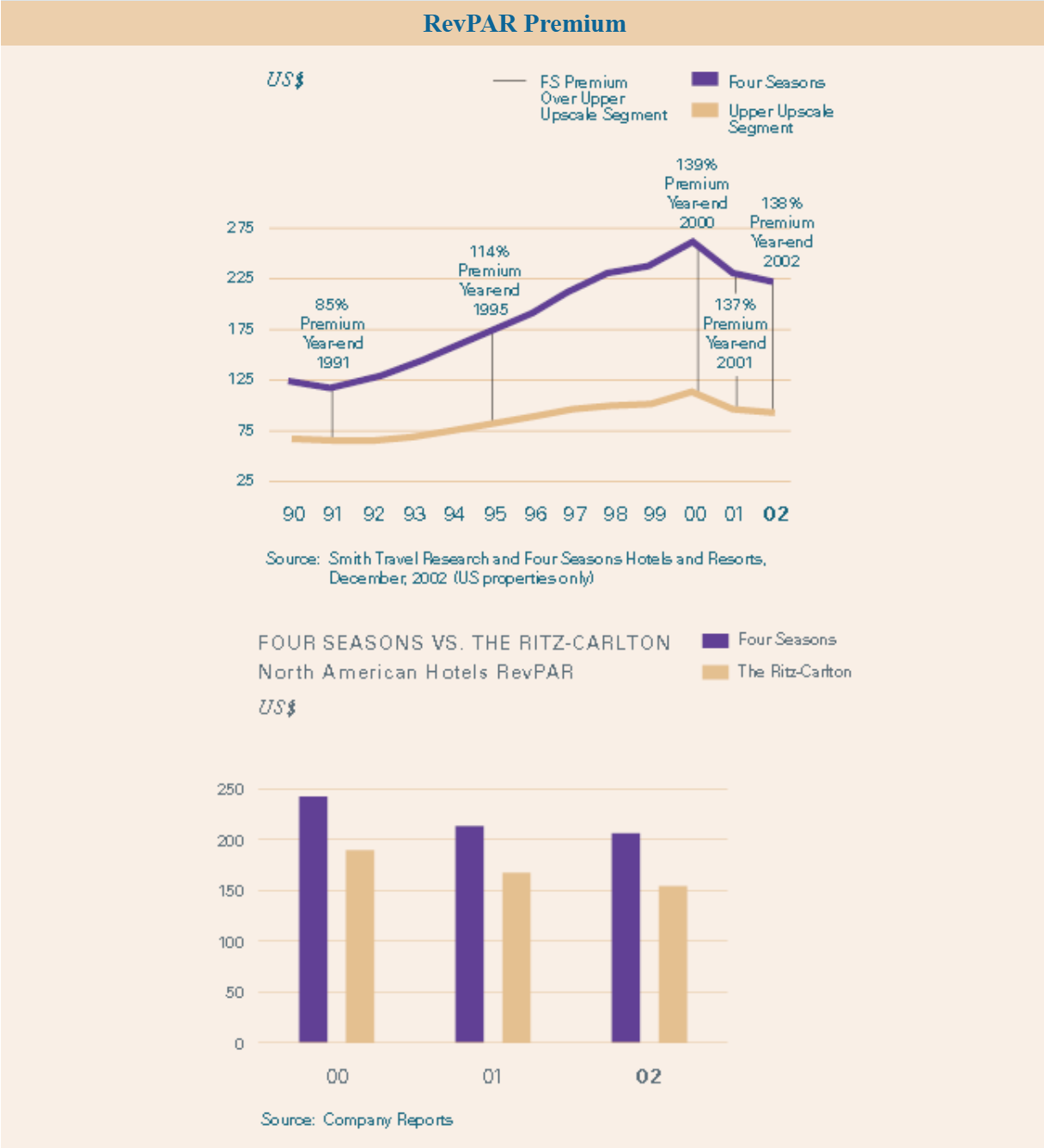
They report RevPAR (revenue per available room) premium over the “upper upscale” segment of the industry; in 2002 it was 138%, which is evidence of the pricing power
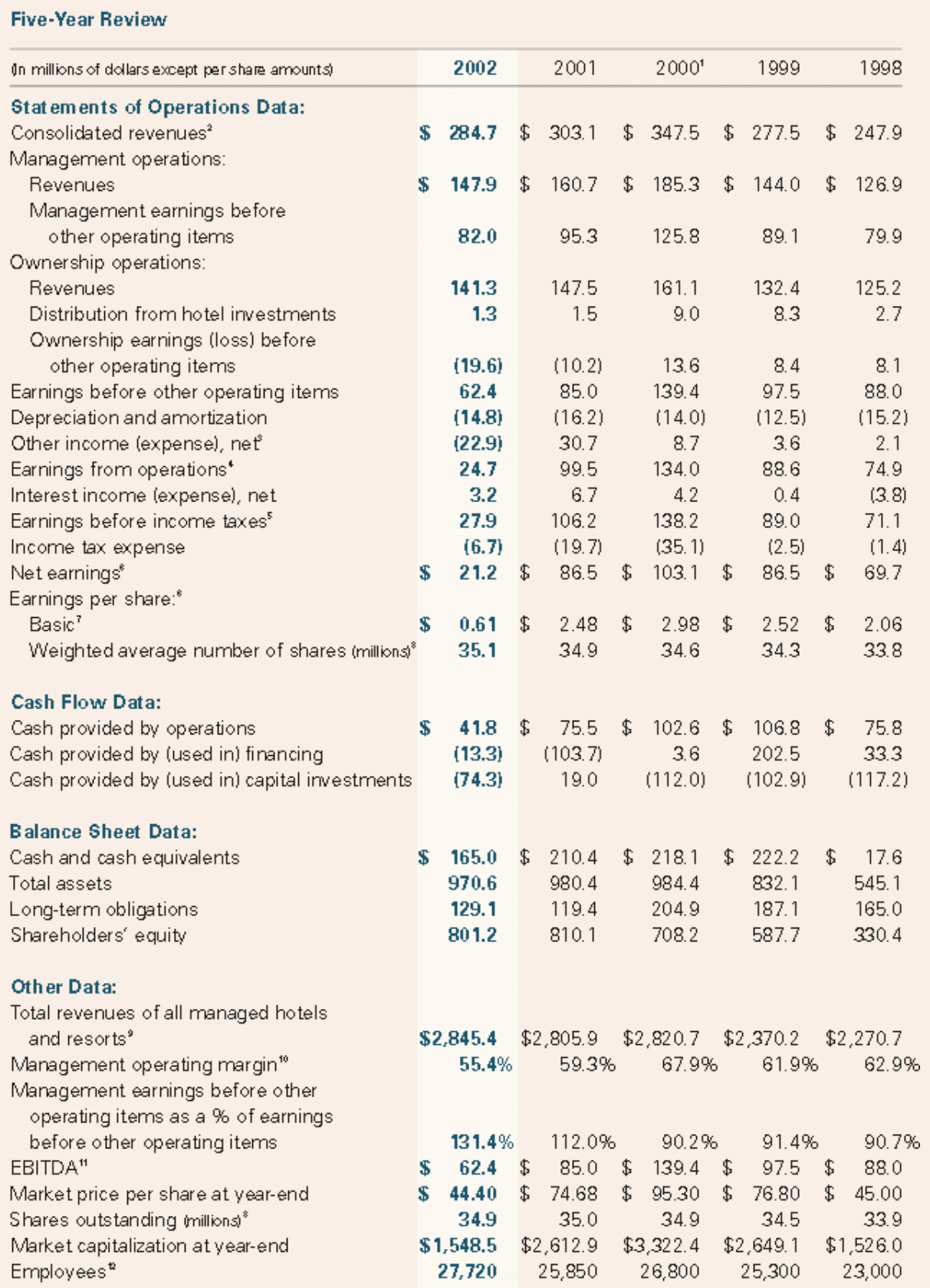
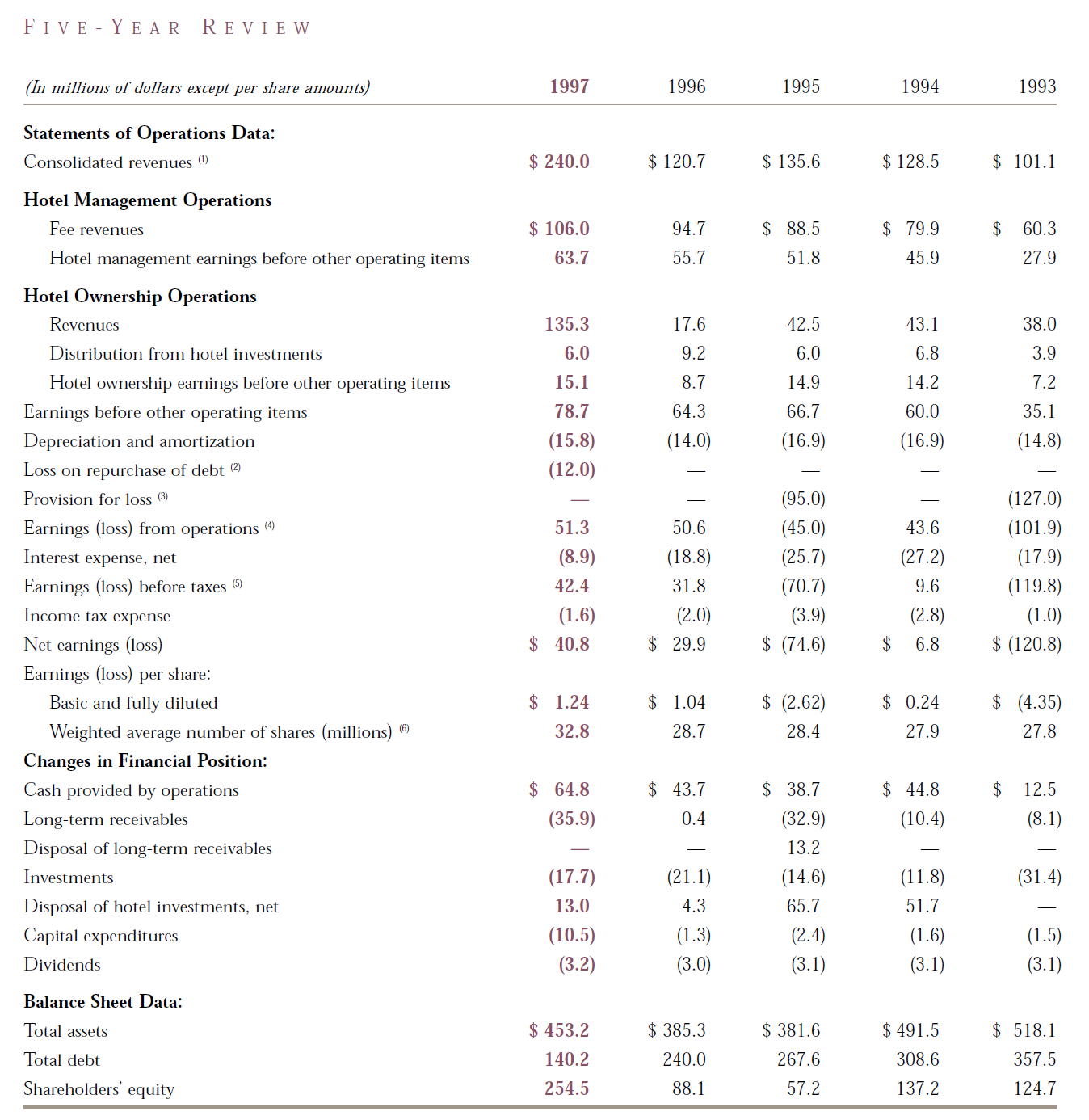
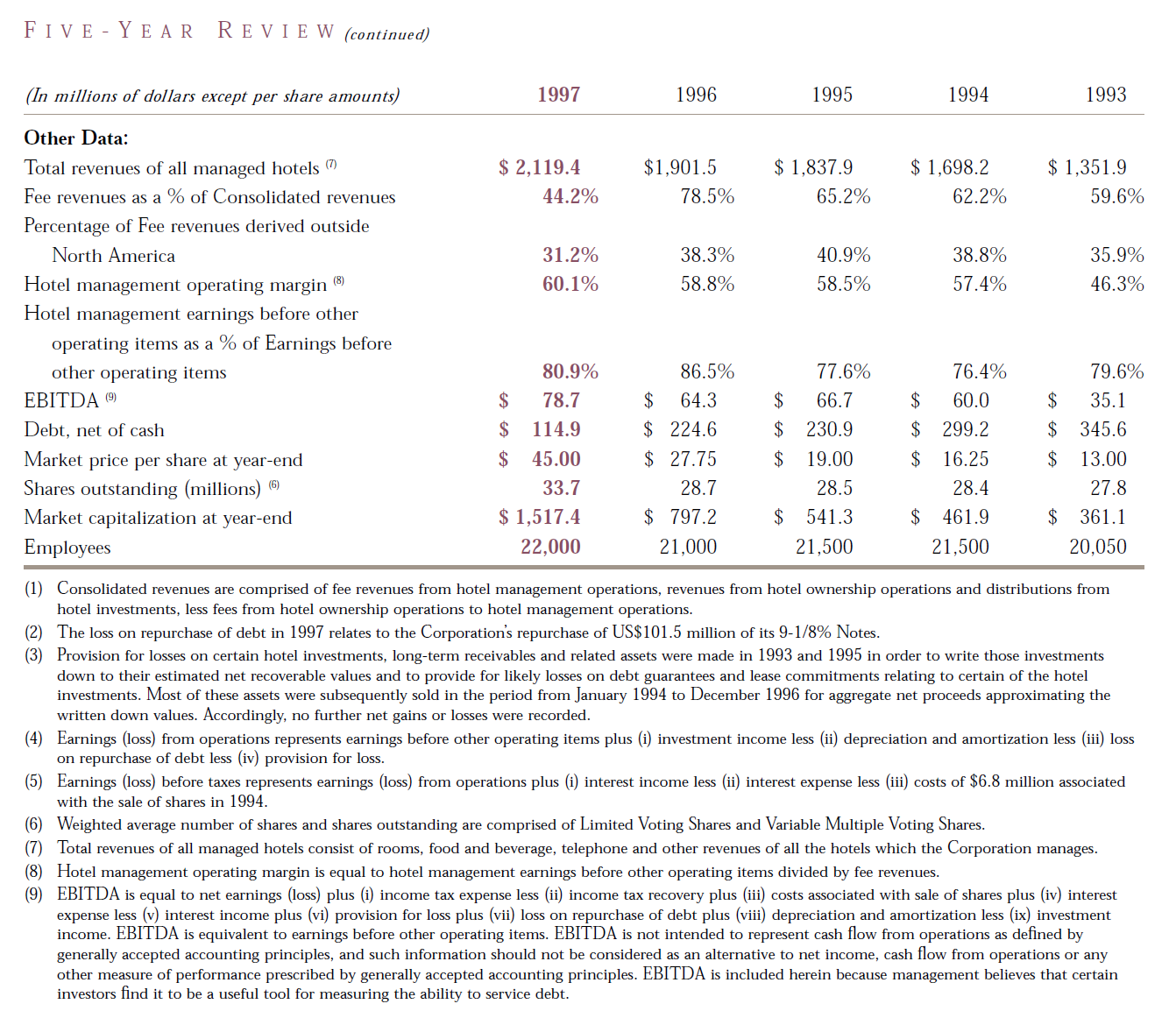
The Five Year Reviews are also nice (below are two). You can see the cyclicality in the revenue and cash from ops but the (eventually) conservative balance sheet enables them to invest countercyclically, to your point in parlaying assets (they divested, plus they had a cash war chest).
Surprised to see how high leverage was in '93-'94, 10x and 5x net debt to EBITDA, respectively. This was coming out of recession and the Regent deal. This amount of leverage was never revisited.
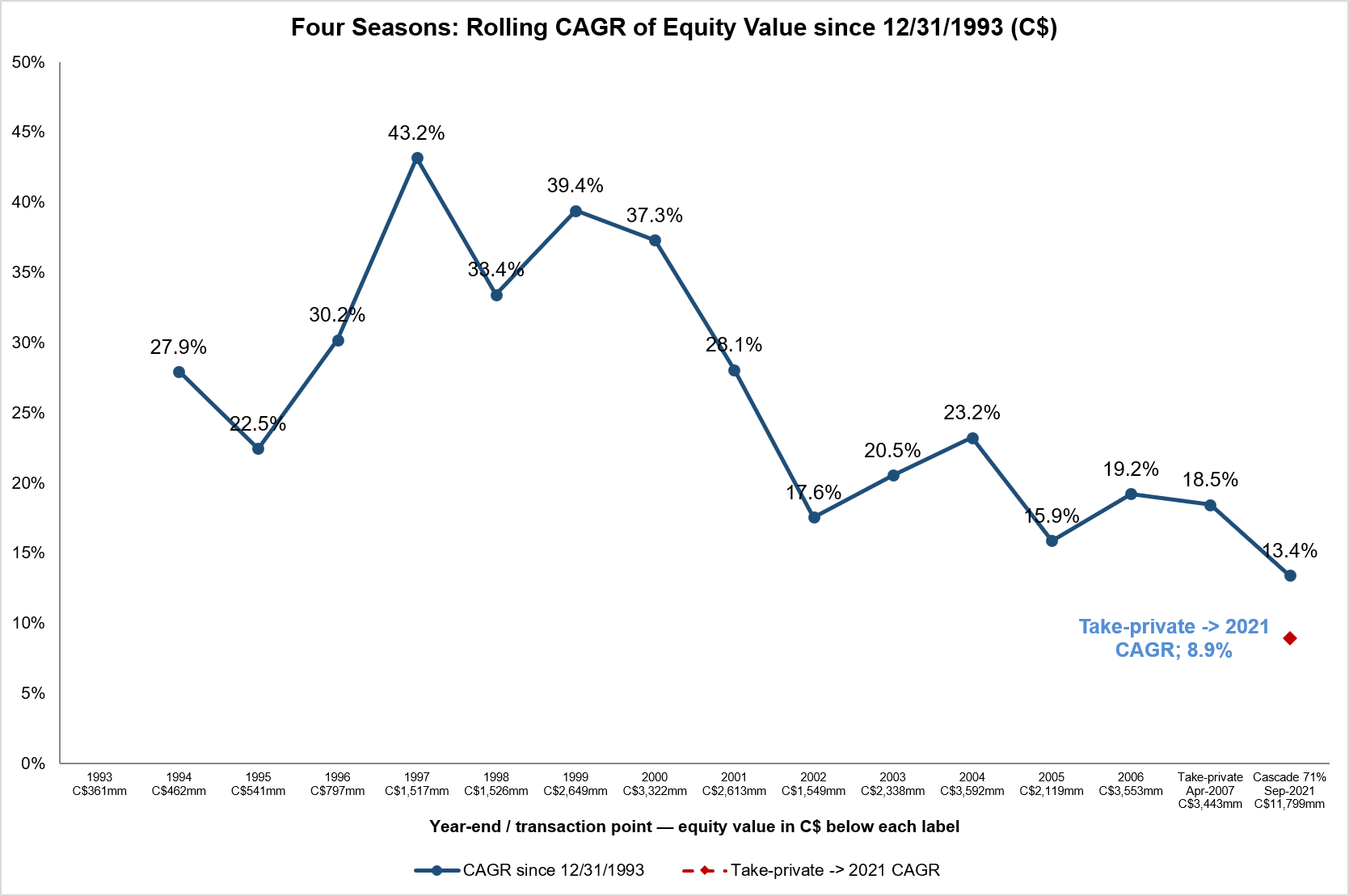
The equity 4x’d from '93 to '97 as they delevered…40% compounded return…then doubled from there in 2000, to go back to where it started in '97 two years later. The take private in 2007 was done at ~$3.4B equity value, Gates majority purchase in 2021 at a $9.3B equity value
Below is the rolling compounded annual return on the equity since the arbitrary starting date of YE 1993, when it was equivalent to a US$500m market cap company today (note returns shown are understated because this is on price only, so excludes dividends and any other cash distributions taken out of the business when it became private). More than satisfactory, in my book!
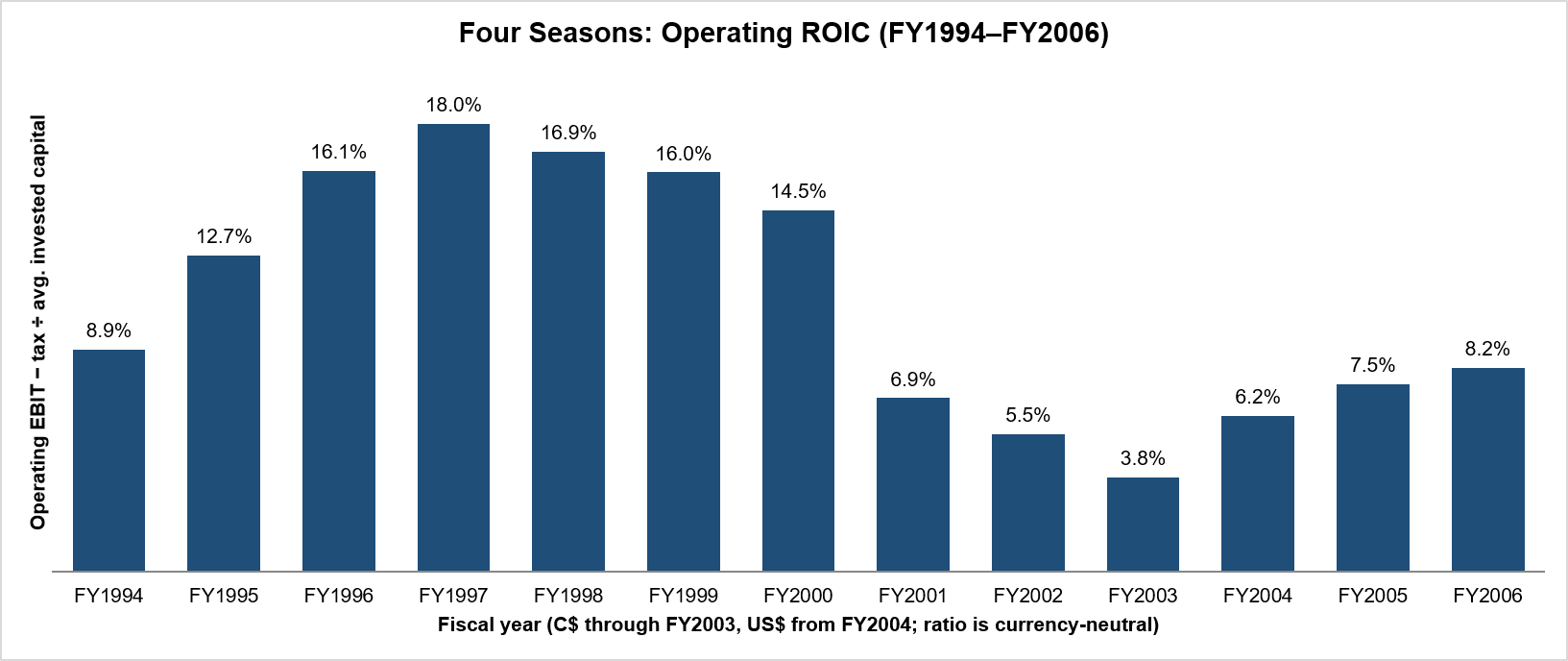
This is an imperfect and AI-assisted calculation of ROIC, but based on the inputs I directed it to include, this should be a directionally correct representation. Interestingly, post-2000, after-tax ROIC wasn’t that good. Suggests that the investments in the management contracts over that period were less profitable (there was a step-change in invested capital while profit languished). I’m sure there’s an explanation but I haven’t dug into it yet.
Agreed! In the context of the hospitality industry at the time, the numbers in the 2002 report are victory lap material, but the tone is pulse lowering, calm and steady
Oh it’s simple: 9/11 in 2001 and the Bali bombings in 2002. Global travel and the broader hospitality industry was decimated for a few years. People were terrified to fly.
(I’m cheating a little because next week’s case is about Four Seasons and recessions )
Right, looks like sales were depressed even through 2006 from prior levels, not quite reaching the 2000 peak in that window. But 2004-2006 seemed to be good demand years? Some of the pressure on the revenue side in this window was because they deliberately shed owned-hotel revenue. Maybe also some front-weighted additional investment in management contracts in that window weren’t yet producing mature profits.

 )